
There is a question that has followed me for years:
Who were we before 300 years of Spanish rule?
Before we were called Filipinos.
Before our names were changed.
Before our stories were rewritten.
Before shame was attached to our skin, language, spirituality, and identity.
Like many descendants of colonised nations, I grew up surrounded by fragments of inherited history without fully understanding where they came from. The deeper I look into our history, the more I realise that the story of the Philippines did not begin with Spain.
We existed…long before they colonised our islands.
We had governance.
Trade.
Spiritual practices.
Laws.
Writing.
Culture.
Identity.
And perhaps most importantly, we had a deep understanding of community, lineage, and belonging.
Who We Were Before Spain Arrived
Before the Europeans arrived in the 16th century, the islands now known as the Philippines were made up of thriving communities connected through maritime trade routes across Southeast Asia. Historians trace the ancestry of many of these communities to Austronesian peoples who migrated thousands of years ago from Taiwan and maritime Southeast Asia, eventually forming links with the wider Malay world.
We were not “uncivilised tribes” as colonial narratives later portrayed them. On the contrary, we were thriving in a similar environment one would find in modern society, but on a smaller scale in terms of population.
Communities called barangays were led by datus and governed through systems of customary law. Coastal settlements traded with merchants from China, India, Borneo, and neighbouring Malay kingdoms long before Spain arrived. Goldsmithing, weaving, tattoo traditions, farming, weapon crafting, art and music, boat-making, and oral storytelling were already highly developed.
We had our own writing systems.
One of the best known was Baybayin, an indigenous script used by Tagalog communities before Spanish colonisation. Early Spanish chroniclers themselves admitted that many natives could read and write.
And then there were the Babaylan.
The Babaylan were spiritual leaders, healers, mediators, herbalists, and keepers of communal memory. Many were women. They held positions of authority and were deeply respected within society.
That mattered.
Because, before colonisation reshaped our worldview, women in many indigenous Filipino societies held influence, dignity, and spiritual significance.
Spain and the Rewriting of Identity
In 1521, Portuguese explorer Ferdinand Magellan arrived in the islands under the Spanish crown. Although he was killed in Mactan by the warriors of Lapu-Lapu, Spain returned decades later and formally colonised the archipelago in 1565 under Miguel López de Legazpi.
The islands were eventually named Las Islas Filipinas after King Philip II of Spain.
For more than 300 years, Spain controlled the archipelago through military force, religion, taxation, and social restructuring.
What followed was not simply occupation.
It was cultural dismantling.
Indigenous names were replaced through the Catálogo Alfabético de Apellidos in 1849, forcing many Filipinos to adopt Spanish surnames for easier colonial administration.
Spiritual traditions were demonised.
Native belief systems were labelled pagan. The Babaylan were persecuted because they represented resistance and ancestral identity.
Christianity spread throughout the islands, and while many Filipinos today hold sincere Christian faith, history must still acknowledge the violence, coercion, and suppression that accompanied conversion.
Spain also introduced racial hierarchies that elevated European identity while diminishing native identity. Over centuries, many Filipinos internalised the belief that lighter skin, European features, Spanish blood, and Western ways were signs of superiority.
The damage did not end when colonisation ended.
It lived on in the mind.
Even today, skin-whitening industries are a booming business across Asia. Some Filipinos avoid speaking Tagalog publicly. Others take pride in appearing “less Filipino,” often without realising how deeply colonial mentality shaped that thinking.
The American Occupation: A New Empire Wearing a Different Face
When Spain lost the Spanish–American War in 1898, the Philippines was not truly liberated. Spain sold the Philippines to the United States through the Treaty of Paris for 20 million dollars.
Filipinos who had already declared independence under Emilio Aguinaldo suddenly found themselves under another foreign power.
The result was the Philippine–American War, a brutal conflict that claimed hundreds of thousands of Filipino lives through warfare, famine, and disease.
Entire villages were burned.
Civilians were forced into controlled zones.
Torture methods such as the “water cure” were documented.
But resistance did not end with Spain.
It simply changed form.
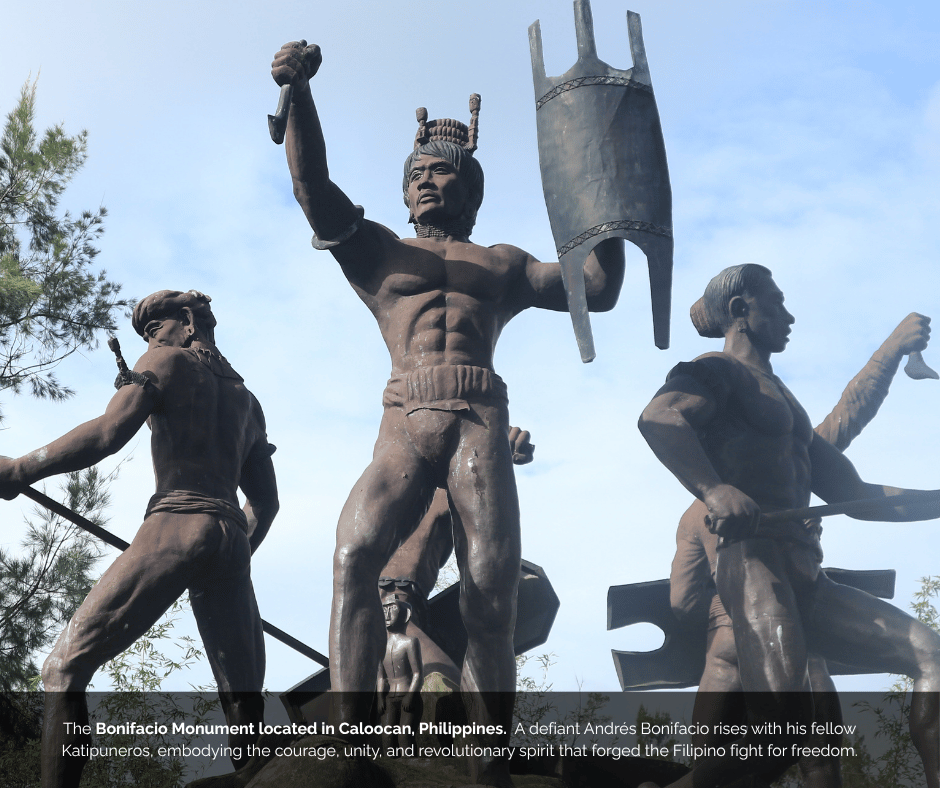
The revolutionary spirit that began with the Katipunan, formally known as the Kataastaasan, Kagalanggalangang Katipunan ng mga Anak ng Bayan (Supreme and Venerable Association of the Children of the Nation), did not disappear even after its early structure dissolved.
Founded by Andrés Bonifacio in 1892, the movement ignited the fight for independence against Spain. And although it no longer existed as a unified force by the time of World War I, its ideals endured.
Former revolutionaries and nationalist leaders carried forward their vision of sovereignty, not only through armed struggle, but through political resistance and advocacy.
The Katipunan may have faded as an organisation, but it never left the Filipino spirit.
America introduced public education, infrastructure, and the English language, and many Filipinos today recognise those contributions. But American rule also reinforced dependence on Western systems and continued reshaping Filipino identity through colonial governance and education.
The message remained, even if it was more subtle:
To be modern was to be Western.
To be “civilised” was to move further away from your roots.
The Japanese Occupation: Fear, Starvation, and Survival
Then came the Japanese occupation of the Philippines during the Second World War.
If Spanish colonisation wounded identity, and American occupation reshaped political and cultural systems, the Japanese occupation battered the Filipino spirit through terror and survival.
The years between 1942 and 1945 were devastating.
Cities were destroyed.
Families starved.
Mass killings occurred across the islands.
Women suffered horrific sexual violence.
Thousands became victims of military brutality.
The Battle of Manila left Manila in ruins and killed over 100,000 civilians. It became one of the most devastated cities of the war, second only to Warsaw.
And yet our people endured and fought.
Guerrilla resistance movements formed across the country.
Ordinary civilians hid families, protected neighbours, smuggled food, and resisted occupation despite immense danger.
Generation after generation, Filipinos learned how to survive suffering. We learned to fight for our freedom.
But survival also came at a cost.
Trauma passed through bloodlines.
Silence became inherited.
Resilience became necessary because hardship became normal.
The Wounds We Still Carry
This is our story as a people.
These events happened centuries ago, and still, we carry the wounds.
Colonisation did not only impoverish the land.
It disrupted identity.
It fractured confidence.
It severed the connection between people and ancestry.
A nation uncertain of its identity struggles to stand fully in its strength.
There is a cost to abandoning our roots.
When you refuse to stand in the truth of who you are, you diminish your own voice.
You reduce your presence.
You weaken your identity.
Filipinos, Pinoys, who dream of fair skin and blue eyes, are not simply following trends. They are living proof of how deeply colonialism still grips their minds.
Those who pretend not to speak or understand Tagalog, believing that English elevates them, are not refined. They are disconnected from their own lineage.
And those who feel shame in calling themselves Filipino must ask themselves a harder question:
What part of yourself are you trying to erase?
We cannot keep blaming history while continuing to live it out.
There comes a point where responsibility shifts.
A point where we must decide:
Will we keep abandoning our roots,
or will we reclaim them?
The Philippines continues to face the realities of a developing nation shaped by corruption, politics, economic pressures, and global inequality. But progress is not only structural. People cannot fully heal while disconnected from their roots. When we are grounded in our identity and lineage, pride and reverence follow naturally, and it is this sense of national pride that powerfully drives true progress.
If you are a Filipino, this is your call to account.
Stand in your identity.
Honour your lineage.
Respect the bloodline stories that made you.
Because a people who forget their roots lose their sense of belonging.
And a person who rejects their own identity will always be searching for worth in places it will never be found.
At this point in history, we have a choice.
We can disregard and abandon our rich history.
Or we can honour it fully.
Not selectively.
Not romantically.
But truthfully.
Reclaim the dignity of our ancestors without denying the complexity of history.
Carrying Both Histories
I now live in the United Kingdom, a British citizen, but always a Filipino in mind, heart and spirit. I am married to a proud Scotsman for whom I have a deep sense of reverence in the ways he honours the memory of his Scottish lineage.
This country gave me and my daughters a home, opportunities, safety, and space to grow and live our lives to the fullest. I embrace that with gratitude and respect.
But within me flows the life, breath, and memory of my ancestral lineage.
In every fleeting second of my life, I am constantly connected to my roots.
I carry the bloodline stories of my forefathers. The resilience of generations who endured colonisation, war, migration, poverty, displacement, and reinvention.
And of that, I am deeply proud to be Filipino.
To honour one’s roots does not require rejecting others.
Identity does not need to exist in opposition.
This narrative is not about bitterness.
It is about restoration.
It is about reconnecting tarnished threads between ancestry and identity.
About understanding how history shaped the Filipino psyche.
About preserving lineage-led narratives before they disappear beneath modern distraction and inherited shame.
Because when a people remember who they are, they begin to walk differently. Tall, assured, and confident.
And perhaps healing begins when we stop viewing our history merely as suffering and seeing ourselves as perpetual victims, and start recognising the extraordinary resilience that carried our people through centuries of conquest, occupation, and survival.